
The “Third Pillar” of Oral Health — And Why Bad Breath Can Persist Even When Nothing Seems Wrong
What this overlooked factor helped me understand — and why it changed how everything else finally made sense.

I’m just normal.
Sometimes I skip a brushing.
Sometimes I leave it for later.
I’m not one of those obsessive brushers.
And I’m definitely not Willy Wonka from Charlie and the Chocolate Factory — the guy with perfect, porcelain-looking teeth.
But overall, I take decent care of my mouth.
Run your tongue along the back of your bottom teeth — that sandy texture?
Look at the back of those teeth in the mirror and you might notice something you don’t usually pay attention to.
But none of that ever felt like a real problem… until my breath started to change.
What confused me wasn’t the change itself.
It was how quietly it happened.
Nothing felt urgent.
Nothing looked wrong.
And there was nothing obvious telling me where to look.
What I didn’t realize back then was why.
I hadn't done anything "wrong".
And yet, it felt like something was slowly drifting out of sync — without giving me anything clear to react to.
Your nose adapts.
There’s even a name for that: nose-blindness — when your brain gradually stops reacting to a smell you’re around all the time.
But the people around you? They tend to notice much sooner than you do.
And that’s where children come in — the tiny, brutal truth-tellers of the world.
One afternoon, my niece looked at me and asked:
It felt like being punched in the stomach.
Because most adults won’t tell you the truth.
They avoid you instead.
They open the car window, hand you gum “for no reason.”
Or lean back just a little during conversations.
So if you’ve ever wondered, “Do I have bad breath?”, there’s a simple — and uncomfortable — way people try to check:
Lick your wrist.
Let it dry.
Smell it.
If it makes you instinctively pull your hand away, that’s close to what other people have been dealing with.
So of course, I went to the dentist for a deep cleaning — because I’m not someone who ignores my oral health.
I paid over $800 out of my own pocket.
Not for answers. Not for peace of mind.
Just for that hollow feeling you get when something expensive ends… and nothing actually feels resolved.
Because even when you’re trying to do everything right, the dentist often just shrugs and tells you to brush better, floss more, use a stronger rinse…
that “your breath should get better.”
On the second visit — with a mouth that was supposedly “very clean” — the dentist noticed mild inflammation and suggested a prescription rinse for a short period.
I went back two more times.
Two follow-up visits.
Two more bills.
And the same confused look on his face every time.
My wallet was empty.
My dignity too.
So I did what most desperate people do — I dove into research.
Forums.
Studies.
Reddit threads.
Anything that could explain why nothing worked.
And that’s when I stumbled on something that stopped me cold.
A simple idea — almost embarrassingly simple — that no dentist had ever mentioned:
Just like a tripod: when one leg collapses, the whole system falls.
Two of the legs are obvious — the things everyone focuses on.
But the third leg… the one everything secretly depends on… is invisible.
And when something invisible starts to shift,
you don’t get alarms.
You don’t get pain.
You just keep doing the visible things — while slowly losing ground underneath.
Why nothing I had tried — not the cleanings, not the rinses, not the brushing — ever really seemed to stick.
Because the leg that was failing…
was the only one no one had ever told me about.
You know that feeling when something finally clicks… and a lot of what used to feel confusing starts to make more sense?
That’s exactly what happened to me when I learned about those three pillars.
Before I understood the invisible one — the one nobody talks about — I had to rethink the two pillars we do hear about all the time.
And honestly?
Pillar #1: Cleaning — Teeth, Tongue, Plaque, All the Obvious Things
This is the pillar everyone knows.
Brush, floss, scrape, rinse — the entire bathroom routine.
The celebrity of oral hygiene.
And yes — it matters.
Nobody wants a mouth full of gunk.
And plaque? It’s basically like letting wallpaper glue dry inside your mouth.
So yeah, cleaning is important.
It keeps things looking nice and helps you avoid that slow, creeping feeling that something’s going wrong.
But here’s the thing:
And that’s exactly why it can feel reassuring — even when something deeper is quietly shifting out of view.
It’s the “front stage.”
The Instagrammable part.
Pillar #2: The Gums — The Part Nobody Thinks About Until Something Feels Off
If the first pillar is the celebrity… the gums are the overworked stage crew holding everything together.
Your gums are supposed to hug your teeth tightly — like a good pair of jeans that fit just right.
But the moment they get irritated or start acting differently…
tiny gaps start opening up.
These little gaps aren’t as harmless as they seem.
And once those gaps open?
Food slips in.
Bacteria throw a rave.
Your body reacts.
Things start looking off.
And your breath starts changing.
Not because you’re dirty.
Because the barrier is failing.
And I never realized how important the gums were until I learned the one fact that made my stomach drop:
quietly enough that nothing feels urgent, and nothing clearly points to where the problem might be forming.”
You can walk out of the dentist with teeth that sparkle like diamonds and gums that look perfectly normal —
meanwhile, underneath, the whole system is quietly falling apart.
And it explained part of my situation… but not the whole thing.
Pillar #3: The Invisible One — The One I Never Knew Existed
Here’s where everything flipped.
One night, after going down a rabbit hole of Reddit threads, I came across something I hadn’t considered before — and it all started with a few comments people had left online:
Those two comments hit me like a brick.
Because for the first time, it suggested something unsettling:
That the problem might not be something I was failing to do —
but something happening quietly, outside my awareness.
I had never even heard the words oral microbiome before.
So I started searching.
For the first time in my life, instead of relying on floss-commercial advice, I tried to look for something more grounded — research, studies, anything I could understand.
And that’s how I ended up reading things like:
The Oral Microbiome and Systemic Health: Bridging the Gap Between Dentistry and Medicine
And honestly:
I’m not a doctor. I’m not a dentist. These papers read like another language.
So I did what any normal human would do:
I put the papers into an AI tool and asked a very simple question:
Here’s how the answer was summarized:
“The summary suggested that, for some people, persistent bad breath may involve more than surface hygiene — including imbalances in the oral environment itself.
Brushing, flossing, and mouthwash can help temporarily, but they may not fully explain what’s happening beneath the surface.”
(If you want to test this prompt yourself, you can — it definitely made me pause.)
What struck me wasn’t any single study.
It was how often the same idea kept resurfacing.
Here’s the pattern that kept coming up:
A kind of mini rainforest.
Its own universe of bacteria — good and bad — living around the gums and shaping the conditions that affect breath.
And like any ecosystem, it doesn’t collapse overnight.
It drifts — slowly — until the balance you were relying on isn’t quite there anymore.
Nobody had ever told me this.
Not once.
Not ever.
And if you don’t know this exists, you can spend years focusing on the wrong part of the picture.
Here’s the part that made me sit up in bed:
Bad breath doesn’t always start on the surface.
In some cases, it seems to involve areas you can’t easily reach —
hidden pockets,
the dark corners,
areas where certain bacteria tend to accumulate.
Some of those bacteria are discussed as producing less familiar odors.
They’re often discussed in relation to sulfur-based compounds — the kinds of smells people associate with:
- rotten eggs
- sewage
- garbage left too long in the heat
And guess what?
Those discussions tend to come up more often when the oral ecosystem — the third pillar — is described as being out of balance.
Because I wasn’t dirty.
I wasn’t lazy.
I wasn’t simply brushing wrong.
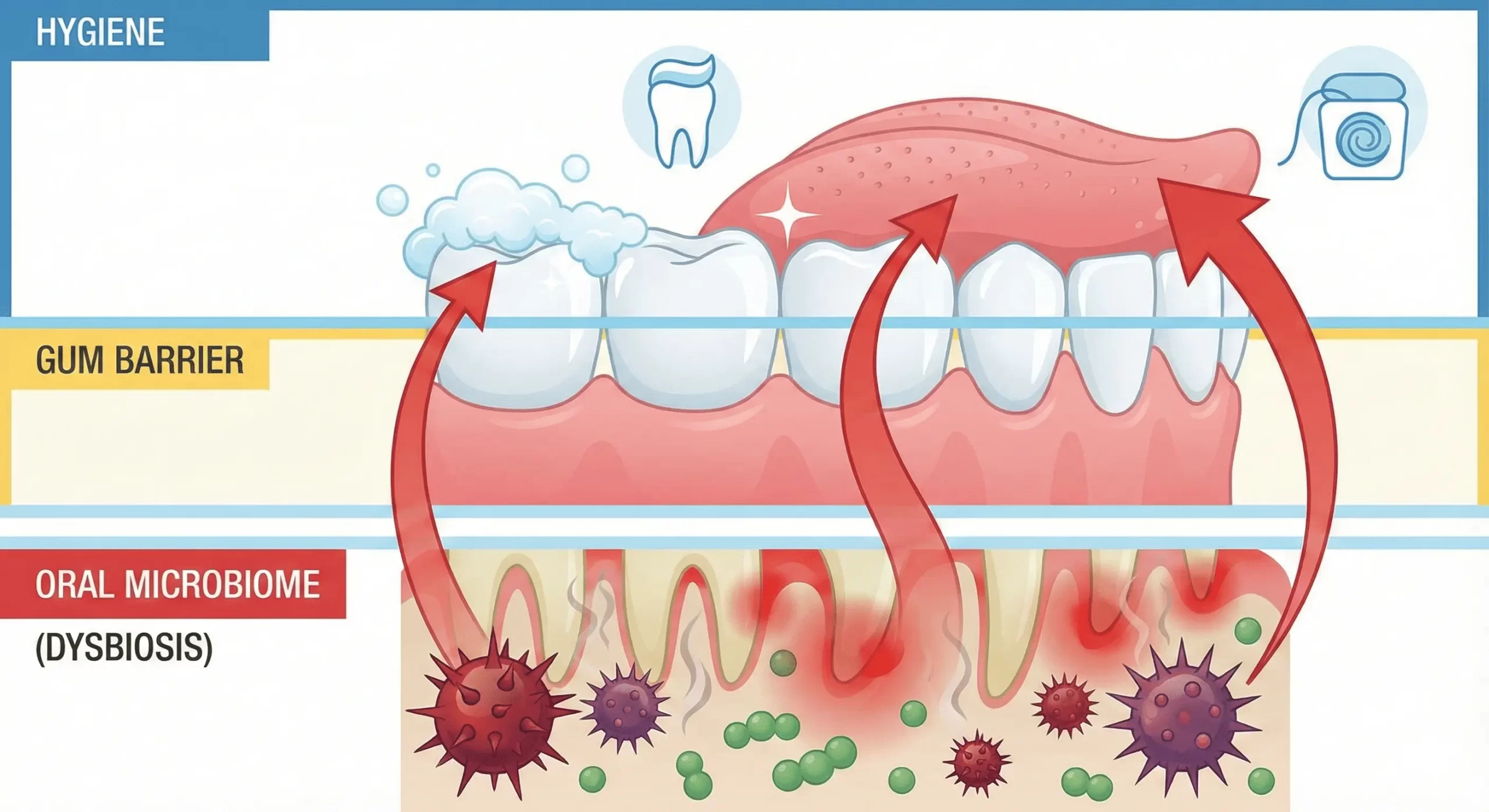
A pillar that can quietly influence how the system behaves over time.
And once I understood that… my journey finally changed direction.
Because now I finally knew:
I needed to pay attention to the part of my mouth that wasn’t showing up in the mirror.”
Looking back, it wasn’t that nothing was happening.
It was that everything happening was subtle enough to ignore —
until it started showing up in ways I couldn’t explain.
Let’s recap.
Yes — oral hygiene matters.
Yes — healthy gums matter.
And yes, problems in both can certainly play a role in bad breath.
But here’s the part many people don’t hear explained clearly:
Because in those situations, you may not be addressing everything that could be contributing to the issue.
You may simply be covering part of it.
It’s like spraying perfume into a trash can.
For a moment, the smell seems fine.
But five seconds later?
It’s right back — sometimes feeling just as noticeable as before.
They make things look clean on the surface…
Now, here are a few real comments from Reddit — followed by a reflection:
Either this isn’t something that typically comes up during routine appointments…
or you start wondering why the guidance never seems to go beyond ‘keep doing the basics.’
But here’s something experience tends to teach you the hard way:
Understanding the framework doesn’t fix anything by itself.
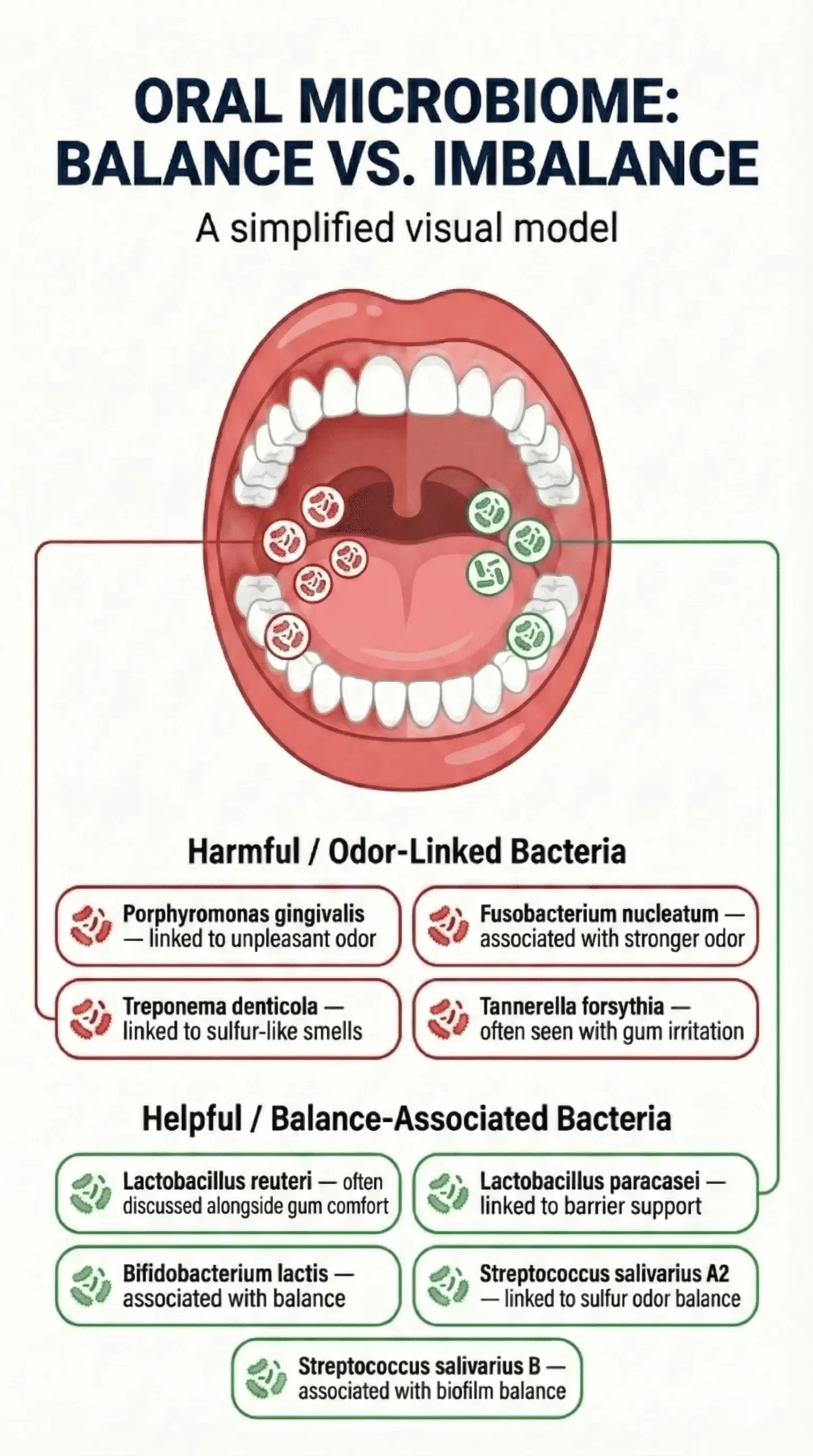
Great — now I understood that certain bacteria are often discussed as part of a typical oral environment.
But how do you even begin to rethink something you’ve been approaching the same way for years?
That’s when something in the study hit me — something I had skimmed over the first time.
The paper didn’t just talk about the oral microbiome.
Suddenly, the framework started to make more sense.
Those awful odors I had been fighting?
I had spent years following standard advice — relying on routines marketed as ‘99% germ kill’.
But seeing this made me pause:
That was the moment I realized something:
If the usual advice wasn’t built around balance,
then repeating it harder wasn’t going to change anything.
And here’s what stood out to me:
If real people on the internet were the ones who opened my eyes to the oral microbiome… then maybe real people could point me toward a direction that made more sense.
I wasn’t looking for some “miracle recipe,” or a TikTok hack promising to “fix” bad breath with lemon and baking soda.
The science had finally given me a framework that made sense — so whatever I explored next needed to align with that logic.
I wasn’t looking for something louder,
stronger,
or more aggressive.
I was looking for something that actually acknowledged that hidden layer —
instead of pretending it didn’t exist.
So I went back to the same places that had helped me before — the forums, the Reddit threads, the quiet corners of the internet where people talk honestly because they’re tired of being embarrassed.
And something interesting kept happening.
I kept seeing the same idea come up:
Not a rinse. Not a toothpaste. Not a mouth spray.
Something people referred to as an oral probiotic.
I remembered I had the scientific study… and maybe I hadn’t asked AI the right question.
So I clarified my situation and asked this:
The answer was immediate:
“From what I understood, the paper mentions probiotics and prebiotics as approaches researchers have explored in relation to oral microbiome balance.”
I didn’t know whether to feel happy or shocked.
It felt almost too simple to take seriously at first.
My teeth had never looked cleaner — after spending a significant amount over the years.
My gums were… fine. Not the rosy-pink ones you see in commercials, but acceptable.
And my breath? Continuing to embarrass me in ways I couldn’t ignore.
As I read further, research discussions kept circling back to the oral microbiome — with probiotics often mentioned as part of that conversation.
Most probiotics people buy are designed with gut health in mind…
aren’t necessarily designed with the mouth as their primary focus.
The oral microbiome involves different types of strains.
Strains discussed as being able to function within saliva-rich conditions.
Others explored for how they interact with gum surfaces and tooth structures.
I didn’t need to think in terms of ‘more probiotics’.
Some formats are discussed as staying in the mouth longer.
In the U.S., probiotics are often associated with pills.
But for the mouth?
Pills don’t always align cleanly with an oral-focused approach.
They’re designed to act after digestion…
and may not interact meaningfully with the mouth.
Even AI tools highlighted that same distinction.
And yet… I felt so close to freedom.
So close to the idea of not being afraid to speak.
Less anxiety in closed rooms.
Less of that instinct to hold my breath mid-sentence.
Less overthinking during conversations.
The awkward giggles.
The sudden step backward.
The car window rolling down — and you can’t help wondering if it’s because of you.
The mint offered “for no reason.”
You smile.
You say thank you.
And inside, you shrink.
It’s about distance.
The quiet kind.
Avoiding closeness before someone else does.
Always holding back. Never getting too close.
Never letting a moment linger -
because what if they notice?
And over time, you don’t even realize you’re doing it.
It just becomes how you move through conversations.
How you position yourself.
How carefully you manage each interaction.
And the hardest part?
That was the picture I kept replaying in my head.

I wanted real connection.
I wanted conversations that didn’t come with constant self-monitoring.
I wanted to stop managing myself.
And for the first time, something important clicked:
I needed a clearer understanding of what might be happening in my mouth.
Once that became clear, everything finally had a direction.
What if I kept understanding the problem…
but never actually changed how I approached it?
Understanding the framework was one thing.
Living as if it mattered was another.
And at that point, doing nothing didn’t feel neutral anymore.
It felt like choosing to stay exactly where I was —
just with better explanations.
how was anyone supposed to approach it in real life?
That question kept surfacing in those discussions
Quietly. Repeatedly.
Until it led me to one specific name.
Not because it was loud or hyped,
but because it was mentioned in a very different context.
I didn’t click because I was ready to buy something.
I clicked because it was the first time something seemed to be built around the part everything else had ignored.
What caught my attention wasn’t a bold promise.
It was the fact that it focused on balance at the source —
instead of trying to clean harder on the surface.
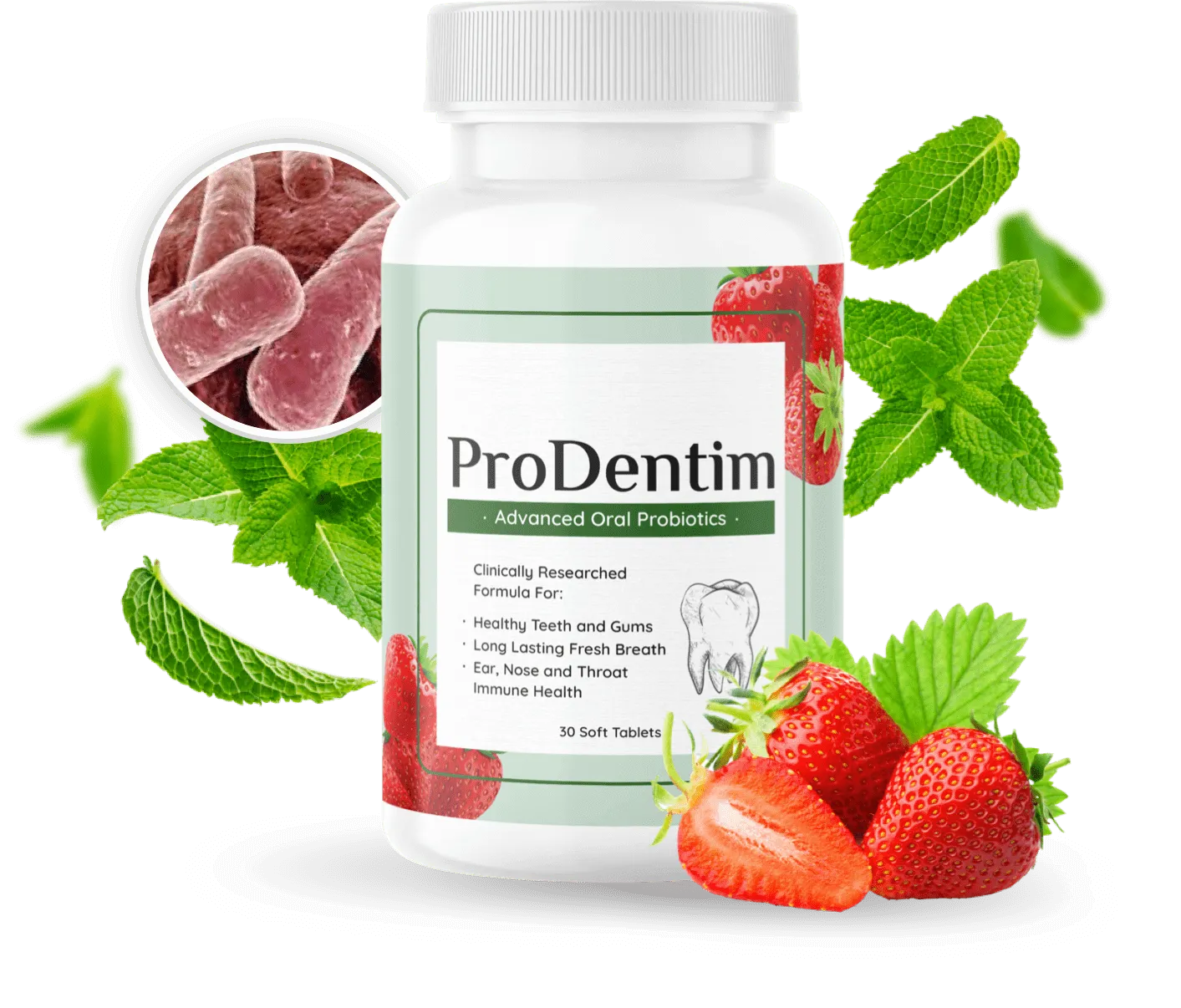
If you want to see the same page I read — the one that explained balance at the source — you can find it here: